
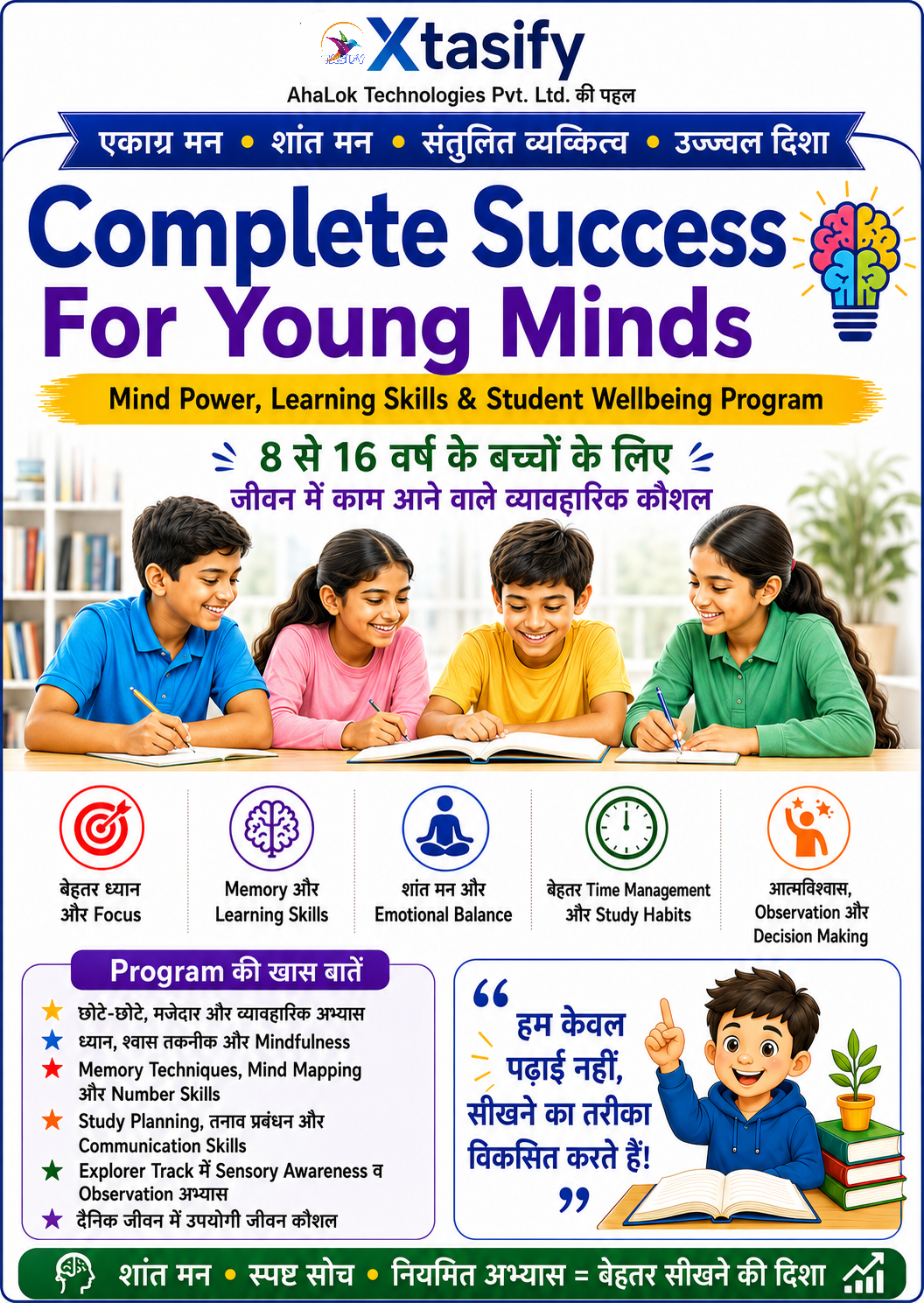
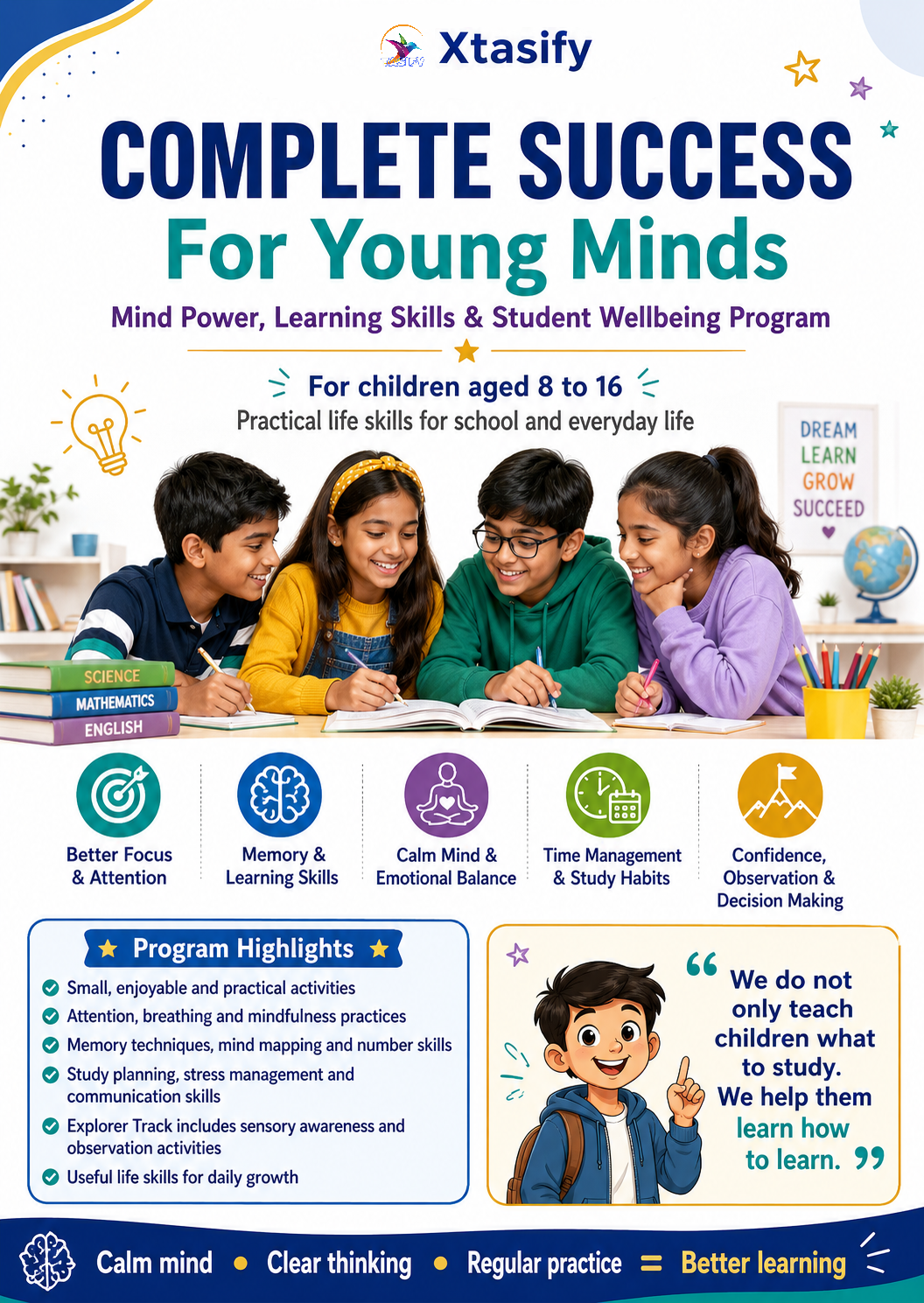
Complete

FOR YOUNG MINDS
Mind Power, Learning Skills & Student Wellbeing Program
A practical five-week learning journey designed to help children develop stronger focus, calmer learning, useful memory strategies, smarter study habits and greater self-management. Children do not simply hear about these skills. They learn, practise, reflect and then use the tools with real schoolwork.NOTICE → GET READY → DO

Complete Success — For Young Minds
Sometimes children do not need more pressure. They need better tools.
A child may be intelligent and capable, yet still struggle because attention, memory, stress, study habits or self-management are getting in the way.
Complete Success helps children practise the skills that support learning — rather than simply asking them to work harder.
Learning how to learn — and how to manage yourself while learning.
Complete Success — For Young Minds is an educational and developmental program that combines attention training, calmness practices, memory strategies, learning techniques and self-management tools.
It is not another tuition class. It does not teach another academic subject. Instead, it helps children practise skills they can apply across subjects and everyday situations.
Six areas, practised together
Focus & Attention
Notice distractions and return attention to one task.
Calmness
Use gentle techniques to prepare the body and mind for learning.
Memory Tools
Use pictures, stories, association, chunking, recall and repetition.
Reading & Learning
Read for understanding and use practical study methods.
Self-Management
Develop routines, planning, stress awareness and consistent practice.
Confidence
Build confidence through preparation, participation and completed action.
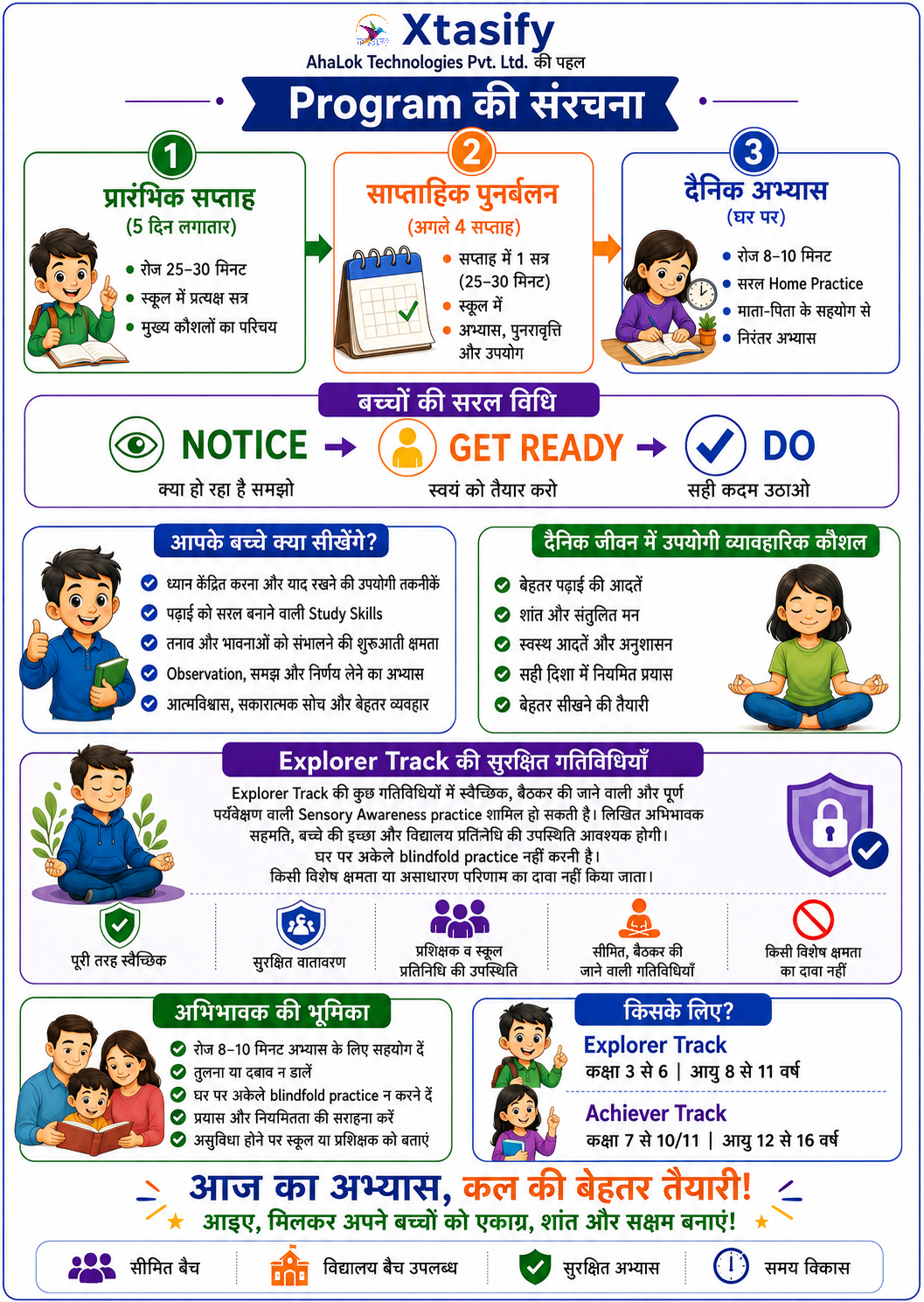
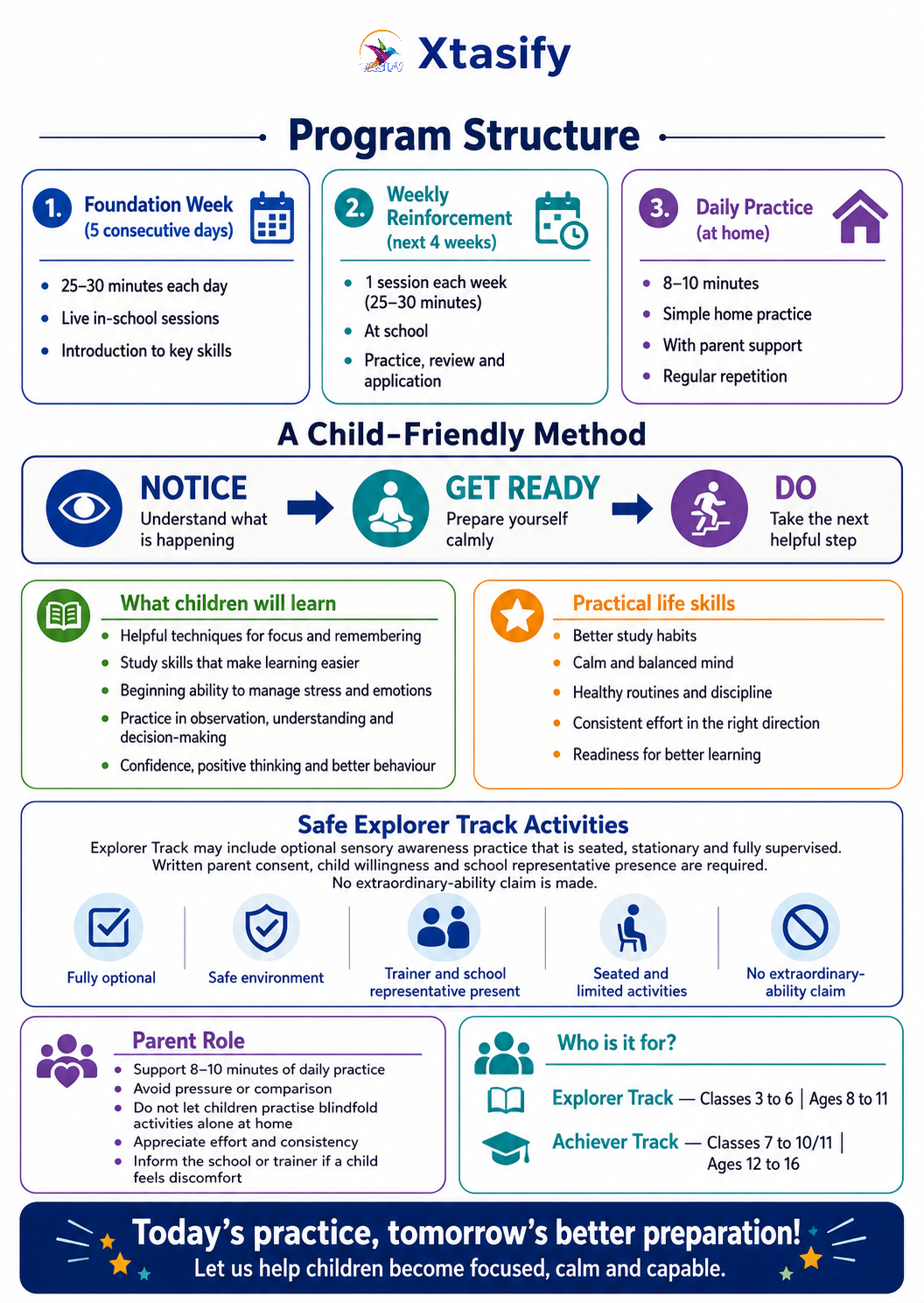
Notice → Get Ready → Do
The everyday tool children use in the moment — before a task, a test, or a tricky feeling.
NOTICE
What is happening?
- What am I feeling?
- What is distracting me?
- What do I need to learn?
- What problem am I facing?
GET READY
Prepare the mind and body.
- Settle attention
- Breathe calmly
- Choose the right learning tool
- Organise the next small step
DO
Take one useful action.
- Begin the task
- Recall without looking
- Practise
- Ask for help
- Complete the next step
Learn → Try → Reflect → Repeat
The pattern behind every session — how a new skill becomes an easy one.
Learn
Understand one small idea.
Try
Practise it safely.
Reflect
Notice what helped.
Repeat
Use the skill again until it becomes easier to apply.
Two age groups. One developmental purpose.
Explorer Track
Ages 8–11 · Typically Classes 3–6- Focus and calmness
- Sensory awareness
- Memory tools
- Mind maps
- Reading basics
- Number confidence
- Learning habits
- Self-awareness
- Confidence through participation
Achiever Track
Ages 12–16 · Typically Classes 7–10/11- Attention and distraction management
- Stress regulation
- Memory and revision systems
- Efficient reading
- Study planning
- Time management
- Communication
- Confidence
- Academic-pressure management
- Self-management
Five weeks designed for learning, practice and reinforcement
A one-day workshop may create excitement. Useful skills need repetition. Complete Success begins with five consecutive Foundation Sessions and then continues with one reinforcement session each week for four weeks.
Foundation
5 consecutive guided sessions
Reinforcement
1 guided session each week
Practice
8–10 minutes of simple guided practice
Small practice repeated consistently is more useful than occasional long sessions.
Nine sessions, one continuous journey
Tap any session to see what happens inside it.
1Notice Your Starting Point
Understand how you learn+
Children identify their current strengths, challenges and one small personal goal. They are introduced to how attention, practice and repetition support learning.
Key ideas: Starting-point reflection · brain and learning basics · small goals · Learn → Try → Reflect → Repeat
2Build Your Attention
Learn to notice and return+
Children explore how attention works, what pulls it away and how to bring it back to one useful task.
Key practices: Attention Spotlight · distraction awareness · sensory noticing · focus practice
Explorer Track may include optional supervised sensory-awareness activities where appropriate.
3Get Calm and Ready
Prepare the body and mind for learning+
Children learn simple ways to settle themselves before study, tests or challenging situations.
Key practices: Comfortable posture · gentle breathing · humming breath · attention settling · Three-Minute Calm Plan
No forceful breathing or prolonged breath holding.
4Remember Smarter
Make information easier to recall+
Children experience practical memory techniques instead of simply being told to memorise harder.
Key tools: Pictures and stories · Memory Chain · Memory Journey · Chunking · Active Recall
5Learn Smarter
Bring the tools into real schoolwork+
Children connect attention, memory and calmness with everyday study. At the end of Foundation Week, each child chooses the tools they will practise over the following weeks.
Key tools: Preview–Read–Recall · reading with a pointer · word groups · mind maps · spaced practice · healthy study breaks
6Make Focus a Habit
Week 2 · Turn practice into a useful habit+
Children review what happened when they used the tools during real study and learn how repeated helpful actions can become easier to use.
Key practices: Focus Reset · Habit Switch · reducing distractions · one-task practice · guided reflection
7Strengthen Memory & Revision
Week 3 · Use the tools with real subjects+
Children apply memory and retrieval techniques to real school subjects and discover how short reviews spaced over time can strengthen learning.
Key practices: Close-the-Book Recall · spaced review · Memory Chain · Memory Journey · revision planning · learning from mistakes
8Manage Yourself Better
Week 4 · Move from techniques to self-management+
Children practise recognising stress, using time better, restarting after distraction and choosing the next useful action.
Key practices: Stress Reset · simple planning · study routines · time awareness · confidence through action
For older students, communication, responsibility and academic-pressure management may also be introduced.
9Review, Celebrate & Continue
Week 5 · See your progress and choose what to continue+
Children revisit their starting point, recognise what has changed and identify the tools that work best for them.
Key activities: Progress review · end-point reflection · favourite Power Tools · personal practice plan · certificate of completion
The program does not end with the certificate. The goal is for children to leave with tools they know how to continue using.
More than nine sessions
- 9 instructor-led guided sessions
- Five-week structured learning journey
- Complete Success student workbook
- Attention and focus practices
- Calmness techniques
- Memory and recall tools
- Reading and learning strategies
- Mind-mapping techniques
- Simple number-confidence activities where appropriate
- Guided home-practice activities
- Starting-point reflection
- End-point reflection
- Practice tracking
- Progress review
- Certificate of completion
Parents support practice — they do not become another examiner.
- Encourage 8–10 minutes of regular practice
- Appreciate effort and consistency
- Avoid unnecessary comparison
- Avoid repeated testing
- Help create a calm practice environment
- Allow children to explain what they learned
- Inform the facilitator/school if a child experiences discomfort or distress
- Do not allow kids to do any blindfold activity alone at home
Praise practice before performance.
A teacher or authorised school representative remains present throughout the student sessions.
- Suitable learning space
- Agreed timetable
- Cohort coordination
- Parent communication
- Teacher or authorised school representative during sessions
- Required consent process
- Feedback and implementation support
Progress is observed — not exaggerated.
Complete Success does not use marks or IQ claims as proof of success. For school programs, an aggregate feedback summary may be provided — these are educational observations, not clinical or psychometric assessments.
- Starting-point and end-point student reflection
- Attention activities
- Memory and recall activities
- Use of learned study tools
- Practice consistency
- Student participation
- Teacher observations
- Parent observations where appropriate
- Ability to explain and independently select useful tools
Not another tuition class. Not another motivational workshop.
PRACTICAL
Children use tools, not just listen to concepts.
INTEGRATED
Focus, calmness, memory and learning habits are developed together.
REINFORCED
Five weeks allow children to practise and return with real experience.
AGE-APPROPRIATE
Explorer and Achiever Tracks use different approaches.
RESPONSIBLE
No exaggerated neuroscience, health or extraordinary-ability claims.
The purpose is not to turn children into "superhuman learners." It is to help them become more aware, prepared and capable learners.
Child safety comes before demonstration.
Complete Success is an educational and developmental program. It is not medical treatment, psychological therapy, diagnosis or special-education intervention.
SENSORY AWARENESS
Explorer Track may include optional sensory-awareness activities. Never claimed as seeing through blindfolds, third-eye activation, midbrain activation or extraordinary sensory ability.
BREATHING & CALMNESS
Gentle, age-appropriate, comfortable, without force and without prolonged breath holding. Children stop if they feel dizziness, breathing difficulty, pain, fear or discomfort.
ALWAYS THE CHILD'S CHOICE
A child may refuse or stop any optional activity at any time. Health conditions requiring clinical support are handled by appropriately qualified healthcare professionals.
Any eye-cover activity must always be
- Optional and voluntary
- Seated and stationary
- Short in duration
- Supervised by an adult
- Performed only with safe materials
Never included
- Walking while blindfolded, stairs, obstacle courses, cycling or running
- Identifying dangerous objects
- Unsupervised practice
- Home blindfold practice alone
A child may refuse or stop any optional activity at any time.
Designed and guided by
Dr. Sachin Sharma
"A child does not always need more pressure to perform better. Often, the child needs better tools, better practice and a calmer way to learn."
Complete Success — For Young Minds is developed and guided by Dr. Sachin Sharma, Founder of Xtasify and Founder & CEO of AhaLok Technologies Private Limited. Dr. Sachin Sharma brings more than 20 years of experience in product development, leadership and entrepreneurship. He is the author of The Aware Being Code, is trained in Clinical Hypnotherapy, and works in mindfulness, meditation, mind-wellness and structured personal-development education.
- Founder & CEO — AhaLok Technologies
- Founder — Xtasify
- Author — The Aware Being Code
- 20+ years of industry, product and leadership experience
- Trained in Clinical Hypnotherapy
- PhD in Vedic Astrology
- Practitioner of Vastu, mindfulness and meditation
Before you enrol
What age group is Complete Success for?+
The program is designed for children and teenagers aged approximately 8–16, with different activities and learning approaches for the Explorer and Achiever Tracks.
Is this a tuition class?+
No. Complete Success does not teach another academic subject. It helps students practise attention, calmness, memory, reading, study and self-management skills that can support learning across subjects.
Will this program improve my child's marks?+
No particular academic result is guaranteed. Marks depend on many factors including subject understanding, practice, school instruction, health, environment and individual circumstances. The program focuses on developing useful learning behaviours and skills.
Is Complete Success therapy?+
No. It is an educational and developmental program and does not diagnose, treat or cure medical, psychological, psychiatric or learning conditions.
How long is the program?+
Five weeks. The program includes five consecutive Foundation Week sessions followed by one reinforcement session per week for four weeks. Total: 9 guided sessions.
How long is each session?+
Approximately 25–30 minutes for Foundation Sessions and around 30 minutes for reinforcement sessions.
How much practice is required at home?+
Usually approximately 8–10 minutes per day. The objective is short, regular practice rather than heavy homework.
Do parents have to teach the child?+
No. Parents primarily support regular practice, encourage effort and provide a suitable environment.
What is the difference between Explorer and Achiever Tracks?+
Explorer Track is designed mainly for ages 8–11 and uses more visual, experiential and playful learning. Achiever Track is designed mainly for ages 12–16 and places greater emphasis on revision, academic pressure, planning, time management, communication and self-management.
Does the program include blindfold activities?+
Explorer Track may include an optional, seated sensory-awareness activity using a soft eye cover. It is not mandatory for program completion.
Can children practise blindfold activities at home?+
Only under responsible adult supervision and according to the instructions provided in the program. Children must never practise eye-cover activities alone.
Does the program teach children to see while blindfolded?+
No. The program does not claim or promise that children can see while blindfolded. It is optional and is not required for program completion.
How is progress reviewed?+
Through student reflection, practice activities, use of learning tools, participation, teacher observations and age-appropriate starting-point/end-point review. These are educational observations, not clinical or IQ assessments.
Is the program conducted online or at school?+
Delivery may vary by cohort. School partnership programs are generally delivered within the school according to an agreed schedule. Other Xtasify student cohorts may be conducted separately when announced.
What happens after the five weeks?+
Students keep their workbook and learning tools and are encouraged to continue using the techniques with real schoolwork.
Better learning does not always begin with more study.
Sometimes it begins with learning how to focus, prepare, remember and practise.
Complete Success — For Young Minds
Small practice. Strong habits. Real skills for school and life.